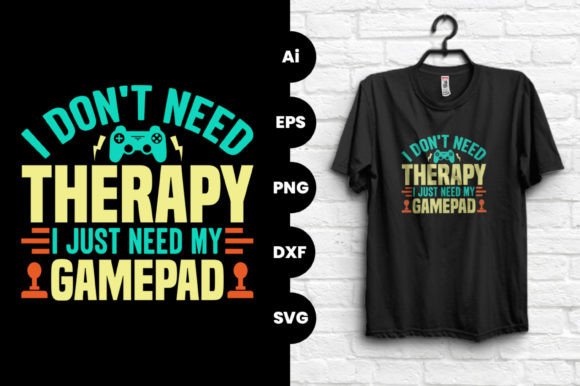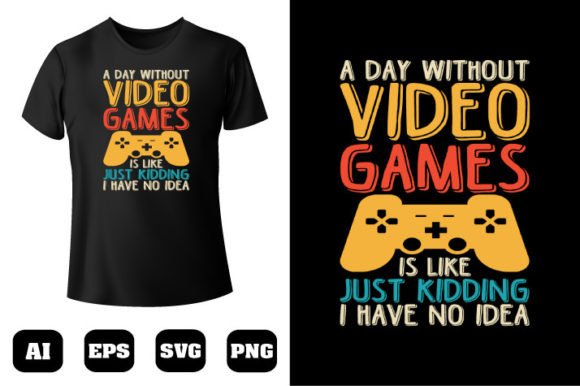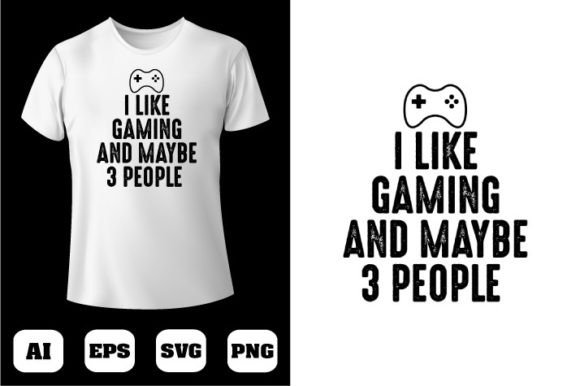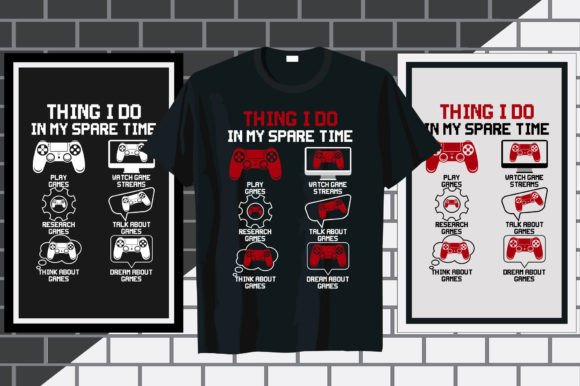
Gaming T-shirt Design 114 and the Rising Art of Wearable Digital Identity
What a gamer wears says as much about their digital soul as the titles they play. Among the most compelling visual statements in modern streetwear and tournament fashion is Gaming T-shirt Design 114, a vector-driven artwork that captures the electric energy of competitive gaming without falling into tired clichés. This particular design has sparked conversation across creator communities, not just for its bold composition, but for what it represents technically — a shift toward fully editable, print-ready assets that empower both boutique apparel brands and independent designers to move faster and produce higher-quality merchandise at scale.
The anatomy of Design 114 reveals deliberate choices that make it more than just another graphic on fabric. Angular geometric shapes intersect with fluid motion lines, creating a visual rhythm that suggests both speed and precision. The composition draws the eye diagonally across the chest placement area, a layout strategy that experienced apparel designers understand makes a garment look dynamic when worn rather than when laid flat. Every element within the design serves a dual purpose: aesthetic impact on first glance and satisfying detail upon closer inspection — exactly what gaming audiences, trained by years of examining intricate UI elements and weapon skins, have come to expect from the products they buy.
Why Vector Foundations Matter for Merchandise That Lasts
The technical specifications of Gaming T-shirt Design 114 reveal why it has become a reference point in apparel production discussions. Built entirely with 100 vector shapes, the design carries none of the resolution anxiety that plagues raster-based artwork. Vector graphics, built from mathematical curves and paths rather than fixed pixels, scale with perfect fidelity from a chest print to a billboard without degradation. For a T-shirt printer receiving files from multiple artists at varying skill levels, receiving a clean vector file eliminates hours of troubleshooting — no jagged edges, no blown-out details, no awkward conversations about whether the client's 72-dpi JPEG can somehow be magically enhanced.
This design package includes AI, EPS, PNG, and SVG formats, a quartet that covers virtually every production scenario imaginable. The AI and EPS files serve as the master working documents, fully compatible with Adobe Illustrator CC and carrying every editable property intact. The SVG format caters to web-based preview tools, screen printing software that prefers open standards, and even direct-to-garment printer interfaces that have improved their SVG handling considerably over recent years. Meanwhile, the PNG provides an immediate visual reference, useful for mockups, client approvals, and those moments when someone simply needs to see the artwork quickly without launching design software.
At 300 dpi, the included raster format meets the threshold where the human eye stops distinguishing individual dots at typical viewing distances. Print professionals consider 300 dpi the gold standard for commercial output, balancing file manageability with reproduction quality. For direct-to-garment machines that operate effectively between 240 and 300 dpi, this resolution ensures the final print translates the design's sharp geometric edges and subtle gradient areas faithfully onto fabric, wash after wash retaining the original crispness that first caught the buyer's attention.
The Practical Advantage of Full Spectrum Color Control
Color versatility stands as perhaps the most underappreciated feature in T-shirt design assets — and Design 114 delivers this with 100 color changeable elements. This isn't merely about swapping a single fill color; it means every distinct visual component within the artwork can be independently recolored, opening up staggering possibilities for brand alignment, seasonal variations, or limited edition drops. A gaming organization with specific team colors can adapt the design to match their palette perfectly without compromising the artwork's integrity. An e-commerce brand running a holiday promotion can shift accents from standard neon green to festive crimson, producing a variant that feels intentional rather than forced.
For creators operating in the highly competitive print-on-demand space, this color flexibility translates directly to commercial advantage. Rather than commissioning separate designs for different colorways — a costly and time-consuming proposition — a single purchase of Design 114 multiplies into potentially dozens of visually distinct product listings. Each variation can target different sub-communities within gaming culture: muted metallic tones appeal to simulation and strategy game fans, while hyper-saturated neons attract the battle royale and FPS crowds. The easy to edit structure means these variations emerge in minutes rather than hours, a pace that keeps small operations agile against larger competitors.
Gaming Culture and the Language of Visual Merchandise
To understand why designs like Design 114 resonate, it helps to examine how gaming merchandise evolved over the past two decades. The early 2000s saw gamer apparel dominated by literal references — game logos, character portraits, and slogan-driven graphics that functioned more as advertisements than fashion. Today's audience operates with greater visual literacy. They gravitate toward designs that reference gaming culture obliquely, through shared visual language rather than overt labeling. Geometric abstractions that evoke heads-up displays, angular compositions that suggest map topography, color palettes pulled from loading screen gradients — these subtler approaches signal belonging without shouting it.
Design 114 connects to this evolved sensibility. Its vector aesthetic mirrors the precision of competitive play — clean lines suggesting optimized builds, efficient movement patterns, and the satisfying clarity of well-executed strategy. Wearing such a design at a tournament or gaming convention communicates insider status without requiring words. The design's ready to print nature also reflects the democratization of merchandise production that parallels gaming's own trajectory from niche hobby to global cultural force.
From Screen to Fabric: The Production Pipeline
The journey of a vector design from computer screen to finished garment involves more technical considerations than most consumers realize — and more than many first-time apparel entrepreneurs anticipate. Screen printing, still the dominant method for bulk T-shirt production, requires artwork to be separated into individual color layers, each needing precise registration marks and trapping adjustments to prevent unsightly gaps between neighboring colors when printed. A cleanly constructed vector file like Design 114 makes this separation process straightforward; each shape already exists as a discrete object that can be assigned to its appropriate screen with minimal manual intervention.
Direct-to-garment printing, increasingly popular for print-on-demand and short-run production, eliminates the need for color separations entirely but introduces its own requirements. DTG printers work best with files that have clearly defined edges, well-optimized transparency, and resolution at or above 300 dpi — all characteristics inherent to this design package. Sublimation printing, favored for all-over prints on polyester fabrics, demands artwork that can bleed edge-to-edge without losing compositional integrity, another area where the 100 vector shapes re-sizable quality proves invaluable.
Each production method also responds differently to various fabric colors and compositions. A design that pops brilliantly on white cotton may lose contrast on heather gray or become muddy on dark backgrounds without proper adjustment. The editable nature of Design 114 allows printers to create dark-optimized variants with adjusted contrast, light-optimized versions with subtle shadow details, and specialty iterations for particular fabric blends — all from the same master file.
Building a Design Library for Commercial Success
Apparel entrepreneurs who build sustainable businesses understand that individual designs, no matter how striking, rarely carry an entire brand. The strategic approach involves curating a library of complementary assets that can serve different purposes within the product catalog. A bold, attention-grabbing piece like Design 114 might anchor a new collection launch, its aggressive composition ideal for social media thumbnails and ad creative that needs to stop scrolling thumbs. Positioned alongside more subdued options, it creates the kind of visual variety that encourages browsing and drives average order value through multi-item purchases.
The file formats provided — AI, EPS, PNG, SVG — support every stage of this commercial workflow. The AI file handles deep customization and variation creation. The EPS format ensures compatibility with older RIP software still powering many professional print shops. The SVG integrates with virtually every modern e-commerce platform's product visualization tools, from automated mockup generators to AR try-on experiences that forward-thinking brands are beginning to implement. And the PNG serves as the reliable preview that marketing teams can drop into presentations, social media templates, and email campaigns without worrying about rendering issues.
For designers who license or sell their work to multiple clients, providing this comprehensive format package removes friction from the purchasing decision. Buyers — whether they run a printing business, manage merchandise for an esports organization, or operate as individual creators — receive everything they need to move immediately into production. No follow-up emails requesting missing formats. No frustrated moments discovering the purchased file doesn't work with their specific setup. The package respects the buyer's time and acknowledges the diversity of tools people actually use in production environments.
Technical Architecture: What Makes a Great Gaming Design Structure
Examining Design 114 closely reveals a number of structural decisions that separate professional-grade T-shirt artwork from amateur attempts. The vector shapes exhibit consistent stroke weights and alignment precision that prevent the design from appearing sloppy at scale. Anchor points are placed economically — enough to define complex curves smoothly, but not so many that the file becomes unwieldy or creates printing artifacts. Layer organization follows logical grouping, suggesting the original creator anticipated the editing needs of future users. Grouped elements that logically belong together — a set of geometric accents, a gradient cluster, a series of motion lines — remain grouped in ways that make color adjustment commands propagate intelligently through related components.
This attention to underlying architecture matters enormously when designs need adaptation for different garment types. Moving artwork from a standard T-shirt to a hoodie often requires adjusting proportions, adding or removing elements to accommodate pocket placement, or reconfiguring the composition to work across zipper-separated panels. A poorly constructed file fights these adjustments at every step; a thoughtfully built one like Design 114 accommodates them naturally, the organized structure guiding the editor toward efficient modifications rather than forcing hacky workarounds.
The 100% color changeable nature extends beyond simple fills to include stroke colors, gradient endpoints, and any transparency effects built into the composition. This comprehensive editability means even subtle aspects of the design — the glow intensity on certain elements, the contrast between foreground and background shapes — can be fine-tuned for specific printing techniques or fabric characteristics. Screen printing on dark garments, for instance, often benefits from slightly bolder strokes and adjusted contrast that compensates for the ink's interaction with darker fabric substrates.
Community, Recognition, and the Creator Economy
The phrase "Follow me for more unique t shirt design. Thank You." accompanying Design 114 reflects something significant about how design discovery and commerce now function. Individual creators, no longer dependent on large studios or agencies for distribution, build direct relationships with audiences through platforms that reward consistency and specialization. Each design release serves simultaneously as a product, a portfolio piece, and a marketing touchpoint that brings followers deeper into the creator's aesthetic universe. The unique visual identity developed across multiple releases becomes a brand that buyers recognize and return to, trusting that new offerings will meet the quality standards established by previous work.
For buyers, following designers who produce work at the caliber of Design 114 means gaining early access to designs before they become widely saturated in the marketplace. A design that performs well commercially will inevitably attract copycats; purchasing early and establishing product listings quickly provides a competitive window that can make a significant difference in crowded niches like gaming apparel. Building ongoing relationships with reliable design sources also reduces the creative overhead required to maintain fresh product catalogs — a constant challenge for merchandise businesses operating with lean teams.
The educational dimension of well-crafted vector designs deserves acknowledgment as well. Emerging designers who purchase assets like Design 114 gain more than a file; they gain a learning resource. Opening a professionally constructed AI file and examining layer structures, anchor point placement, grouping logic, and color organization teaches through exposure. Each element becomes a reference for how to approach similar challenges in original work. Over time, designers who study quality assets alongside creating their own compositions develop faster than those working in isolation, the combination of analysis and practice accelerating skill development in measurable ways.
Printing Quality and the Uncompromising 300 DPI Standard
The insistence on high quality with 300 dpi isn't arbitrary — it represents a decision point where quality collides with practical constraints in visible ways. Below 200 dpi, most viewers can detect softening of edges and loss of fine detail at standard viewing distances. At 150 dpi, designs that feature intricate geometric patterns or text elements begin to suffer noticeably, the crisp precision that defines gaming aesthetics dissolving into something that looks accidental rather than intentional. By maintaining 300 dpi as the baseline, Design 114 ensures that even the most detail-rich sections of the artwork reproduce with the clarity the original composition demands.
This resolution standard applies specifically to output at 100% scale. Because the underlying artwork is vector-based, the effective resolution exceeds 300 dpi at any practical print size — the included PNG simply delivers a raster snapshot at the most commonly requested specification. Printers who need to produce at larger dimensions can export from the AI or EPS source file at whatever resolution and scale their specific equipment requires, a flexibility that raster-dependent designs fundamentally cannot match.
Understanding these technical distinctions helps buyers make informed decisions about which design assets merit investment. A beautiful concept executed without production-ready specifications might serve as inspiration but adds little practical value to a printing workflow. Design 114 bridges inspiration and execution, delivering artwork that performs as impressively on fabric as it does on screen.
Future-Proofing Through Format Diversity
As printing technology evolves and new production methods emerge, the value of owning designs in multiple formats compounds over time. Laser engraving on apparel, growing in popularity for premium and technical garments, requires artwork with exceptionally clean vector paths. UV printing on accessories and hard goods benefits from designs that maintain structural integrity when separated from their original context. Embroidery digitization — converting flat artwork into stitch files — achieves better results when the source artwork provides unambiguous shapes rather than complex overlapping elements that confuse the digitizing software's path detection.
Owning Design 114 in AI, EPS, PNG, and SVG formats means the design can journey into these emerging applications without degradation. The vector formats feed precision-dependent processes; the raster format handles quick previews and e-commerce integration. This format diversity essentially future-proofs the investment, ensuring the artwork remains useful as production methods continue to diversify.
The gaming apparel market shows no signs of slowing — each new game release, esports season, and streaming platform milestone creates fresh demand for merchandise that helps fans express their connection to gaming culture. Designs that combine technical quality with resonant aesthetics position themselves at the center of this ongoing expansion. Design 114, with its meticulous vector construction and comprehensive format package, exemplifies the kind of asset that enables creators, printers, and brands to participate in this growth efficiently and professionally, turning pixels and paths into garments that people genuinely want to wear.