Mastering the Gaming Screen Panel Frame Template for Modern Streamer Visuals
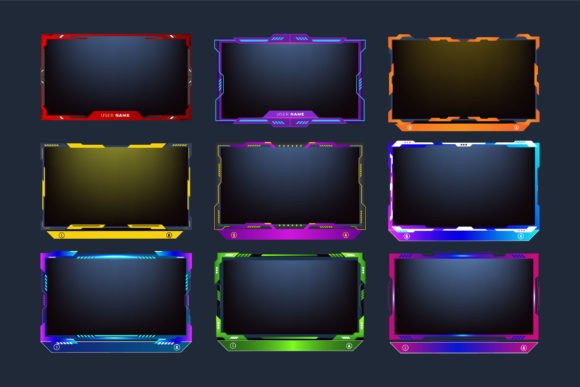
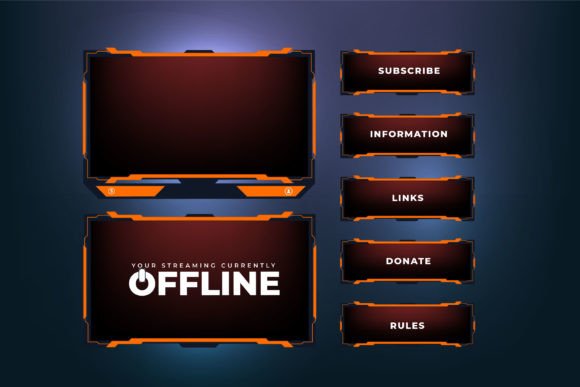
The visual identity of a live streamer or content creator often hinges on the smallest design details. A Gaming Screen Panel Frame Template serves as the structural backbone for broadcast overlays, providing a polished and professional boundary that frames gameplay footage, webcam feeds, and informational widgets. These templates have evolved from simple rectangular borders into intricate, futuristic compositions that blend neon aesthetics with functional interface elements, particularly when accented with orange color shapes against dark backgrounds.
Understanding how these frame templates function and why they matter requires looking beyond surface-level decoration. Every curve, gradient, and button placement within a gaming screen panel frame template influences viewer perception, stream organization, and brand consistency. The rise of customizable vector files has democratized access to high-quality designs, allowing individual creators to achieve visual parity with established esports organizations.
The Anatomy of a Futuristic Gaming Frame Design
A well-constructed gaming panel frame integrates multiple visual layers that work in harmony. The outer border typically features geometric precision with angled cutouts, hexagonal motifs, or dynamic slash patterns that evoke speed and technology. Inside this boundary, secondary accent lines in vibrant orange create depth through contrast with the dark background, drawing the eye toward the content rather than distracting from it.
Orange has become a signature color in gaming interface design for specific reasons grounded in color psychology and screen visibility. On dark or black backgrounds common in streaming setups, orange wavelengths cut through without causing the eye strain associated with pure red or the cold sterility of blue. When applied to gaming screen panel frame template elements, orange shapes can highlight active states, indicate live status, or simply add warmth to an otherwise stark technological layout.
The futuristic aesthetic relies heavily on asymmetry and layered transparency. You might observe a frame where the upper-left corner carries a heavier decorative load with angular brackets and glowing nodes, while the lower-right section thins out to a minimal line weight. This uneven distribution feels organic despite its mechanical origins, mimicking how actual heads-up displays in science fiction media prioritize information density in specific zones.
Structural Components Worth Examining
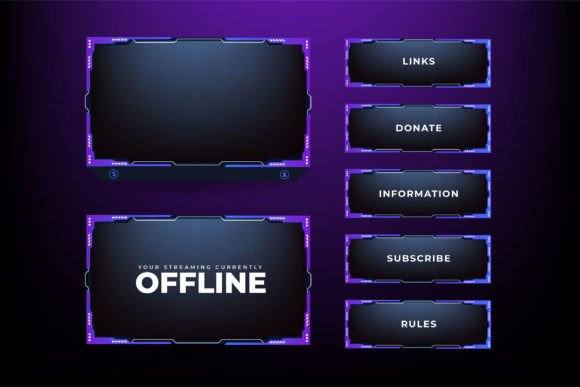
Breaking down a typical design reveals several recurring modules. The primary containment border establishes the overall footprint. Within or adjacent to this border, smaller compartmentalized sections host stream labels, social media handles, donation trackers, or subscriber goals. Online buttons integrated into the frame itself eliminate the need for separate overlay elements, creating a unified interface where every pixel serves a dual decorative and functional purpose.
These online buttons are not merely static graphics. In their editable vector form, they can be assigned specific on-stream behaviors through streaming software, becoming clickable donation links, channel subscription prompts, or platform redirects. The orange color coding often distinguishes between action types, with brighter shades indicating primary calls to action and muted tones reserved for secondary information.
Practical Applications Across Streaming Platforms
Whether broadcasting on Twitch, YouTube Live, Kick, or Facebook Gaming, the underlying mechanics of frame implementation remain consistent. A streamer imports the vector file into their broadcast software such as OBS Studio or Streamlabs Desktop, positions it as a top-layer source, and then nests gameplay or camera feeds beneath it. The frame acts as a window, revealing only what sits within its transparent center while masking everything outside its boundaries.
Professional esports productions use these frames to standardize player camera placements across multi-perspective broadcasts. When eight individual player feeds must coexist on screen simultaneously, matching gaming screen panel frame templates create visual cohesion that prevents the layout from feeling chaotic. Tournament organizers often commission custom frame sets with sponsor branding embedded directly into the border decoration, turning every second of screen time into subtle advertising space.
Independent content creators benefit equally from this approach. A consistent frame template applied across all stream scenes—starting soon, live gameplay, intermission, and outro—establishes brand recognition faster than any verbal introduction. Viewers scrolling through a platform directory can identify a familiar streamer by their unique frame design before even reading the channel name.
Live Streaming Frame Border Design for Dynamic Content
The concept of a live streaming frame border design extends beyond static image files. Many modern templates include animated variations where orange accent lines pulse gently, corner brackets slide into position during scene transitions, or particle effects drift along the border perimeter. These motion elements signal to viewers that the broadcast is active and responsive, reinforcing the live nature of the content.
Implementing animated frames requires working with formats that support transparency and motion, typically WebM video files or sprite sheets. However, the foundational design originates in the same vector template that serves static scenes. This scalability from still image to motion graphic demonstrates the versatility built into properly constructed design files.
Vector Format Advantages for Customization Workflows
Receiving a design in vector format fundamentally changes what a creator can accomplish with their frame template. Unlike raster images composed of fixed pixels, vector graphics use mathematical paths that remain infinitely scalable. A frame designed at 1920 by 1080 pixels can be expanded to 4K or even 8K resolutions without any quality degradation, future-proofing the investment as display technology advances.
Adobe Illustrator remains the industry standard for vector editing, though alternatives like Affinity Designer, CorelDRAW, and the free Inkscape application provide comparable functionality. When a creator receives files compressed into a ZIP archive, the first step involves extraction using utilities like WinRAR, WinZIP, or the native extraction tools built into modern operating systems. Simply double-clicking the archive in most cases will reveal the contained vector files alongside supplementary JPG previews.
The editable nature of these files means every orange accent shape can be recolored to match alternative brand palettes. The dark background layers can be adjusted for different opacity requirements. Online button labels can be rewritten for any language or platform. Even the frame proportions can be modified to accommodate unconventional aspect ratios used by mobile streamers or vertical short-form content creators.
Layering Strategies for Complex Overlays
Advanced users often decompose a single gaming screen panel frame template into its constituent parts, assigning each to separate OBS sources with independent visibility toggles. The outer decorative border might remain permanently visible, while internal compartment frames appear only when relevant information needs displaying. This modular approach prevents visual clutter during intense gameplay moments while preserving the option to reveal full interface complexity during downtime segments.
Another layering technique involves duplicating the frame, applying a slight blur and reduced opacity to the copy, and offsetting it behind the original. This creates a glow effect that enhances the futuristic aesthetic without requiring actual light emission calculations. The orange elements particularly benefit from this treatment, gaining a neon-like luminescence that reads beautifully against dark backgrounds on LED and OLED displays alike.
Design Considerations for Different Content Genres
The ideal frame aesthetic varies significantly between gaming categories. Horror streamers might prefer distressed textures and muted orange tones that suggest rust or decay rather than clean technology. Competitive first-person shooter broadcasters often favor minimal frames that occupy the smallest possible screen real estate, preserving peripheral vision for gameplay awareness. Role-playing game streamers, conversely, embrace elaborate fantasy-inspired frames with ornamental flourishes that complement narrative immersion.
A flexible gaming screen panel frame template accommodates these divergent needs through smart layer organization. Starting from a comprehensive master design that includes all decorative elements, a creator can progressively disable layers until they reach their desired complexity level. This subtractive approach proves more efficient than attempting to composite multiple simple frames into a cohesive complex layout.
The orange color family itself offers surprising range. Burnt orange conveys warmth and approachability, suitable for community-focused chill streams. Neon safety orange demands attention and pairs well with high-energy competitive content. Peach-tinted oranges soften the technological edge for lifestyle broadcasters who game casually. The vector format's precise color controls unlock this full spectrum without degrading the underlying design integrity.
Typography Integration Within Frame Structures
Text placement represents one of the most challenging aspects of overlay design. The frame must provide clear zones where stream labels, player names, and statistical readouts remain legible against any background content. Designers solve this by incorporating semi-transparent backing plates into the frame template itself, positioned precisely where text elements will reside. These plates use subtle gradients that transition from near-opaque behind the text to fully transparent at the edges, avoiding harsh rectangular cutouts.
When orange shapes serve as text backdrops, careful contrast management becomes essential. Dark text on an orange field maintains readability even when compression artifacts or low bitrates degrade stream quality. Conversely, white text requires deeper orange values with sufficient saturation to preserve legibility. Testing across multiple devices—desktop monitors, tablets, and smartphones—reveals whether these color relationships hold up under real-world viewing conditions.
File Management and Distribution Practices
Receiving design files in compressed ZIP format represents an industry standard that balances file size with organizational clarity. A single archive typically contains the editable vector file in AI or EPS format, a flattened JPG preview for quick reference, and occasionally supplementary font files or license documentation. Extracting these contents properly ensures the vector editing application can locate all linked resources without generating missing asset errors.
For those encountering difficulties during the editing process, the original designer often provides direct support channels. Whether the challenge involves locating specific layers within a complex Illustrator document, understanding how to export assets at correct dimensions for streaming software, or troubleshooting color profile mismatches between design applications, reaching out for guidance can save hours of independent troubleshooting.
The community surrounding gaming screen panel frame template design continues to grow as more individuals recognize the impact of professional presentation on audience growth. What began as niche graphic design products has matured into an essential creator toolkit component, bridging the gap between raw gameplay capture and broadcast-ready content that commands viewer attention in an increasingly competitive landscape.
Future Directions in Gaming Interface Aesthetics
The trajectory of gaming frame design points toward greater interactivity and responsiveness. Emerging technologies allow frame elements to react to in-game events, changing color when a player takes damage or flashing orange during critical match moments. These dynamic behaviors transform the passive border into an active storytelling device that enhances viewer engagement without requiring streamer intervention.
Augmented reality streaming introduces additional possibilities where the frame exists partially in virtual space, appearing to float before the streamer rather than simply sitting on top of the video feed. Depth-aware rendering could allow game elements to occasionally break the frame boundary during explosive moments, creating moments of visual surprise that delight audiences and generate shareable clip content.
As display resolutions continue climbing and HDR technology becomes standard in consumer monitors, the subtle gradients and glow effects within these dark background templates will achieve new levels of realism. The orange accent shapes that currently appear vibrant on SDR displays will gain additional luminance range, creating genuinely eye-catching highlights that leverage the full capabilities of modern display hardware.
The fundamental value proposition of a well-designed gaming screen panel frame template remains constant even as technology evolves: it provides structure to visual chaos, identity to anonymous gameplay, and professional credibility to passionate amateurs. Understanding the principles behind these designs empowers creators to make informed choices about their visual presentation, whether they work from pre-made templates or eventually commission fully custom solutions tailored to their unique streaming persona.