The Power of Humble Humor: Why the “I’m Sorry” Gaming Gamer T-shirt Design Is Reshaping Niche Merchandise
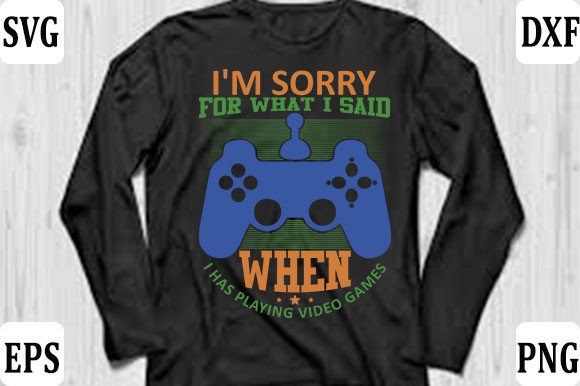
The language of gaming has always been a strange cocktail of technical jargon, inside jokes, and raw emotional outbursts. Among the most recognizable phenomena is the post-rage apology—the moment a player has to turn to their friends, partner, or roommate and sheepishly mutter, “I’m sorry for what I said when I was playing video games.” This phrase has transcended voice chat and living rooms to become a cultural touchstone. It now lives on a tangible product: the Gaming Gamer T-shirt Design, I’m Sorry. But this is not just a funny slogan on fabric. For creators, entrepreneurs, and marketers, it represents a powerful intersection of niche community targeting, ready-to-use design assets, and the growing market for emotionally intelligent consumer goods.
When you purchase a product bundle like this, you are not simply buying a T-shirt. You are acquiring a creative toolkit. The ZIP file typically contains 1 EPS File, 1 SVG File, 1 PNG File, and 1 DXF File. This collection of formats is the industry standard for anyone looking to launch or scale a print-on-demand brand, a custom apparel line, or a gaming-lifestyle merchandise store. The versatility of these file types speaks directly to the needs of modern creators who require precision, scalability, and compatibility across cutting machines, screen-printing software, and direct-to-garment printers.
The Anatomy of a Viral Gamer Apology
To understand the commercial value of the Gaming Gamer T-shirt Design, I’m sorry for what I said when I was playing video games artwork, we must first dissect the psychology behind the phrase. Competitive gaming triggers a intense fight-or-flight response. The anonymity of online play combined with high stakes often leads to “gamer rage.” The apology that follows is not just an apology; it is a ritual of re-entry into a calm social space. Wearing that apology on a T-shirt is a form of pre-emptive peacemaking. It is a self-deprecating badge of honor that says, “I am passionate, I get heated, but I am self-aware.”
This self-awareness is a key trend in modern consumer behavior. Millennials and Gen Z audiences, who make up the vast majority of the gaming demographic, are drawn to brands that eschew polished perfection in favor of authenticity. A Gaming Gamer T-shirt Design, I’m Sorry isn't aspirational in the luxury sense; it is relatable. It closes the gap between the brand and the consumer by acknowledging a universal truth: we all say things we do not mean in the heat of the moment, especially playing games like Call of Duty, League of Legends, or FIFA.
The Technical Backbone: EPS, SVG, PNG, and DXF Assets
From a production standpoint, the value of this product lies in its file diversity. Professionals do not have time to redraw low-resolution rasters. They need a seamless pipeline. Let’s break down why the inclusion of EPS, SVG, PNG, and DXF formats in the ZIP file is a non-negotiable standard for serious garment decoration.
- EPS (Encapsulated PostScript): The gold standard for vector scaling. Print shops and professional screen printers rely on EPS files to maintain crisp, flawless lines regardless of size. Whether the design is going on a small chest pocket or a full back-print, the EPS ensures no pixelation.
- SVG (Scalable Vector Graphics): The modern standard for web-based print-on-demand platforms. Services like Shopify, Etsy integration apps, and vinyl cutting software prefer SVG for its lightweight code and color-separation capabilities. It is editable in open-source software, making it accessible for freelancers and small studios without expensive Adobe subscriptions.
- PNG (Portable Network Graphic): The visual proof of concept. A high-resolution PNG with a transparent background allows creators to instantly generate mockups for their online stores. This is the sales driver—the file you drop onto a lifestyle photo of a smiling gamer holding a controller to convince a customer to click “add to cart.”
- DXF (Drawing Exchange Format): A critical addition for the physical craft market. DXF files bridge the gap between graphic design and hardware. They are essential for automated cutting machines like Cricut, Silhouette, and laser engravers. If a small business wants to apply this Gaming Gamer T-shirt Design, I’m sorry for what I said when I was playing video games to a mug, a trucker hat, or a heat-pressed tote bag using a vinyl heat transfer, the DXF is indispensable.
Monetizing the Moment: Print-on-Demand and Niche Branding
The global gaming merchandise market is expected to surpass billions in the coming years, but the landscape is shifting. Generic “Level Up” and “Player One” motifs are fading into the bargain bin. Consumers now demand specificity. They want shirts that map to the exact subculture they inhabit. A Gaming Gamer T-shirt Design, I’m Sorry targets the specific moment of conflict resolution, not just general gaming pride.
For entrepreneurs leveraging the print-on-demand (POD) model, this design file bundle drastically reduces the barrier to entry. With a single purchase, a marketer can launch multiple SKUs. Because the ZIP file includes fully scalable vectors, the design can be adapted across a product catalog without loss of quality—hoodies, long-sleeve tees, tank tops, and even home decor items like throw pillows. The scalability of a single vector asset is what transforms a $15 design purchase into a potential revenue stream of thousands of dollars, all without holding inventory.
Consider the lifestyle of the modern freelancer: a graphic designer might buy this asset to serve a client who runs a streaming channel. A Twitch streamer can take the PNG file, brand it with their channel logo, and set up a merch shelf for their “subscriber-only” apologies. The crafty stay-at-home entrepreneur can take the DXF file and create glitter-laden iron-on shirts for their Etsy shop titled “Gamer Apology Tees.” The versatility is found in the format flexibility that connects creative expression with market demand.
The Cultural Shift: Gaming as a Social Identity
Why are people paying attention to a phrase like this? Because gaming is no longer a hobby hidden in the basement; it is a primary social identity. With the rise of platforms like Discord, YouTube Shorts, and TikTok, the private outbursts of gamers have become public entertainment. The Gaming Gamer T-shirt Design, I’m sorry for what I said when I was playing video games capitalizes on what sociologists call “confession culture.” It is funny because it is true. It acknowledges a domestic friction that millions of households experience.
This design resonates particularly well with significant others of gamers—the partners who often bear the brunt of a competitive losing streak. A "gamer apology" shirt might be purchased by a gamer as a joke, but data suggests it is equally bought as a gift for a gamer by their partner. The Gaming Gamer T-shirt Design, I’m Sorry functions as both a joke and a peace offering. This dual-utility increases its viral potential and market longevity compared to a standard meme shirt. It solves a social problem—whether literally or humorously—by acknowledging the reality of gaming-induced irritability.
Designing for Longevity in a Fast-Fashion Meme Economy
The digital design marketplace is saturated with ephemeral memes that have a shelf life of a week. A political punchline or a fleeting TikTok audio clip may spike quickly but becomes obsolete just as fast. The beauty of the “I’m sorry for what I said when I was playing” sentiment is its permanence. Video games are not a fad, and neither is the anger they occasionally induce. This phrase has been relevant for decades, dating back to split-screen Mario Kart rivalries in childhood basements. It will likely remain relevant as long as multiplayer queues exist.
For entrepreneurs and marketers, this is a crucial insight: foundational emotional truths outperform topical trends. A Gaming Gamer T-shirt Design, I’m Sorry does not require a specific character name, a celebrity endorsement, or a copyright license from a major game developer. It is a generic human observation. This makes it an evergreen product. You can list this design today and sell it year-round without worrying that the internet has moved on. The design's value is in its text-based communication and typographic styling—pure vector art that speaks a universal language.
Workflow Integration: From ZIP to Zippy Sales
How does the professional creator need to use these files today? The workflow expectations have changed. A few years ago, a 300 DPI JPEG was enough. Now, the market demands precision automation. When a seller integrates with a dropshipping service like Printful, Printify, or Gelato, the AI-guided mockup generators handle the PNG layer gracefully, but the EPS and SVG files are what ensure the final product passes quality control.
Furthermore, the inclusion of a DXF file opens commercial avenues beyond online apparel. Physical event vending is a massive profit center. At gaming conventions, LAN parties, or college esports tournaments, local vendors can use the DXF file to quickly cut heat-transfer vinyl and press shirts on-site. The immediacy of watching your shirt be made in front of you capitalizes on the impulse-buy nature of live events. The entrepreneur with the right file formats doesn't just sell online; they dominate the pop-up economy. The Gaming Gamer T-shirt Design, I’m sorry bundle empowers this hybrid (online and brick-and-mortar) sales approach, which is increasingly necessary in a diversified retail climate.
Creative Customization and Typography Trends
The typographic treatment in these design packages matters. The “I’m Sorry” design often utilizes bold, collegiate-style gothic fonts contrasted with a subtle cursive script for the “sorry,” implying a rough exterior hiding a soft interior. This trend in streetwear typography mirrors the broader fashion world's move toward mixed-typeface collage. The EPS file allows a designer to disassemble the text, change a color fill to match a specific team palette, or add a distressed texture to give the Gaming Gamer T-shirt Design, I’m sorry for what I said when I was playing video games a vintage band-tee feel.
As AI design tools become more prevalent, the demand for high-quality, human-designed vectors ironically increases. Smart creators know that AI-generated images often lack clean stroke paths, making them nearly impossible to cut with a vinyl cutter. A professionally crafted DXF file is a mathematically precise path. It is the antithesis of the muddy blob that an AI raster might produce. In buying this ZIP file, the creator is purchasing reliability and mathematical certainty, eliminating the risk of a ruined batch of shirts due to a faulty vector node. This ties into the larger market shift toward high-trust creative assets in an era of suspiciously cheap, low-quality digital goods.
Consumer Expectations and the Directness of the Message
Modern consumers, particularly gamers, are hyper-aware of advertising. They hate being “sold to.” However, they love being understood. The Gaming Gamer T-shirt Design, I’m Sorry doesn't feel like a product; it feels like an inside joke you can wear. By transferring this design onto a physical garment, the wearer is signaling emotional intelligence and a sense of humor about their own failings. It softens the image of the competitive gamer. It humanizes them.
For marketers, this is a masterclass in user-generated branding. When someone wears this shirt, it sparks a conversation. A fellow gamer sees it in the supermarket and nods knowingly. A non-gamer parent sees it and asks questions. The shirt does the marketing for you. The versatility of the included PNG file allows you to seed this design on social media stickers and digital “photos” in Apple iMessage or Discord servers, further driving organic word-of-mouth back to the primary product listing. It is transmedia merchandise where the digital asset (PNG/SVG) serves a community function beyond the physical textile sale.
Conclusion: Profiting from the Apology Economy
The Gaming Gamer T-shirt Design, I’m sorry for what I said when I was playing video games is more than a single print file; it is a packaged response to a cultural behavior. The ZIP file containing 1 EPS, 1 SVG, 1 PNG, and 1 DXF equips the modern entrepreneur with the raw infrastructure needed to tap into the very lucrative intersection of gaming culture, universal humor, and relational catharsis.
As the creator economy matures, the separation between the winners and the noise becomes technical preparation. Winners don't download a single low-res JPG; they download an industry-standard toolkit ready for the screen printer, the vinyl cutter, the web mockup, and the laser engraver. By investing in a flexible vector design that acknowledges the messy, hilarious reality of digital leisure, you are staking a claim in a market that values speed, scalability, and universal, simmering truths. It proves that in the high-stakes game of merchandise sales, sometimes the best way to say “you win” is by wearing a shirt that says you lost your cool—and you are sorry.